Discovering Hippel's wine bar

Like many others, I have been fascinated for some time with Hippel’s wine bar (Hippel’s weinstube). It is a location associated with a radical group of philosophers called “the Free” (Die Freien) who regularly met their for informal and rowdy philosophical discussion. The bar is usually discussed in connection with Karl Marx and his early development especially considering it was at this bar that he met his long term literary partner Friedrich Engels. Outside the life of Marx, these philosophers certainly have their own relevance, and online much attention is paid to the anarchist Max Stirner and his visits to this bar. Despite this important role, not much seems to be known about the bar itself. For this reason I decided to do a little research and see what I could find.
The wine bar
The main source to look at is John Henry Mackay and his work “Max Stirner: His Life and His Work”, which contains a chapter on the bar and is by far the greatest account of this location. He lists the bar being at Friedrichstraße 94 in Berlin, operating out of a house. Writing in 1897, he claimed that it was still standing opposite the Central-Hotel which had been built in 1881. It’s original owner was J. C. R. Hippel, who ran the business for decades, followed by his wife after his death, and finally by their son, Jakob Hippel, starting in 1841. Hippel was usually taciturn, but always stood attentively in his corner and inwardly took part in the doings of his guests. The entrance to the bar was on the ground floor, with a long table in the middle of a spacious, undecorated room just to the right after entering.
Mackay claims that the Free still met at Hippel’s in 1848, but that the premises had moved. He says it moved either in autumn 1847 or spring 1848 to Dorotheenstraße 8 which had more spacious rooms. During the revolution of 1848 the bar apparently became a kind of headquarters for various radical currents. Hippel tried to keep the various camps apart and distribute them appropriately. Mackay tells us Hippel again moved his wine bar in 1853 to Rosenstraße 3 in Werder, in the corner behind the Werder Church.
The gatherings
The tone of the gatherings was very diverse. Sometimes they would simply play a game of cards with little spoken and heavy smoking. One game they played was called “Kreuz- oder Eichel- Mariage” / “Cross or acorn marriage” which refers to the French and German card suits of clubs and acorns. Sometimes, especially when more of the younger people were present, the whole long table was occupied from one end to the other in intense, loud discussions.
One reason the Free enjoyed Hippel’s as much as they did was because he lent money. On one occasion his patience came to an end and he refused to give further credit, making the Free angry, causing them to relocate to Unter den Linden, where they held a “war council” and finally decided to beg along the street. They were said to have had particular luck as one of the very first strangers took the whole company back to Hippel’s, where they drank until dawn. They repeated this scheme a number of other times.
Other locations
Already mentioned are Dorotheenstraße 91, which Hippel’s bar operated from 1847/1848 to 1853, when it then moved to Rosenstraße 3 “in the corner behind the Werder Church”. Mackay also provided some other locations. Before the group became passionate about Hippel’s bar they tried three other locations:
In Poststraße, behind Nicholas Church, on the corner of Eiergaße, the beer tavern “Zum Kronprinzen,” run by Kernbach. A roomy but low and “sparsely lighted” guestroom.
Again in Poststraße, in the newspaper publishing house “Alte Post”, was the wine tavern of Walburg (or Wallburg).
A beer bar in Kronenstraße was said to have often served for the first meetings of the “Athenaer und Freunde des Volkes” / “Athenians and friends of the people” .
More important than any of these is Stehely’s cafe and confectionery. According to what I have been able to gather, Stehely’s cafe was just as much a part of the routine of the Free as Hippel’s was. Often the day would begin in the reading room there (”the famous red room”) and later continue into the night at Hippel’s. The journalists, poets, and more respectful of the group would center on this earlier part of the gatherings, while the rowdier lot would spend more time at Hippel’s.
I found some information, including a painting of the interior, on Stehely’s cafe and confectionery from an article called “3. Mai 1806: Gefangen in der Jägerstraße“ by Alexander Glintschert. Surprisingly this article also references a wine bar (weinstube) run by J. Hippel, although not the one at Friedrichstraße, but rather at Jägerstraße. Indeed it is the same J. Hippel and the article mentions how this successful bar led to a few others popping up around the city including one at Friedrichstraße 94. Another work (Faust: ein dramatisches Gedicht in drei Abschnitten, Bände 1-2) corroborates this story that “at Jägerstraße 37, there was situated the best-known of the wine taverns bearing the name ‘Hippel,’”, listed in 1833 as ‘Fuß-Hippel.’” and that there was a second wine tavern bearing the name ‘Hippel,’ at Landsberger Straße 42. Humorously Alexander’s article states that, in contrast with the Friedrichstraße bar, “the wine bar in Jägerstraße nevertheless remained the most famous”. Perhaps that is more true in German than in English.
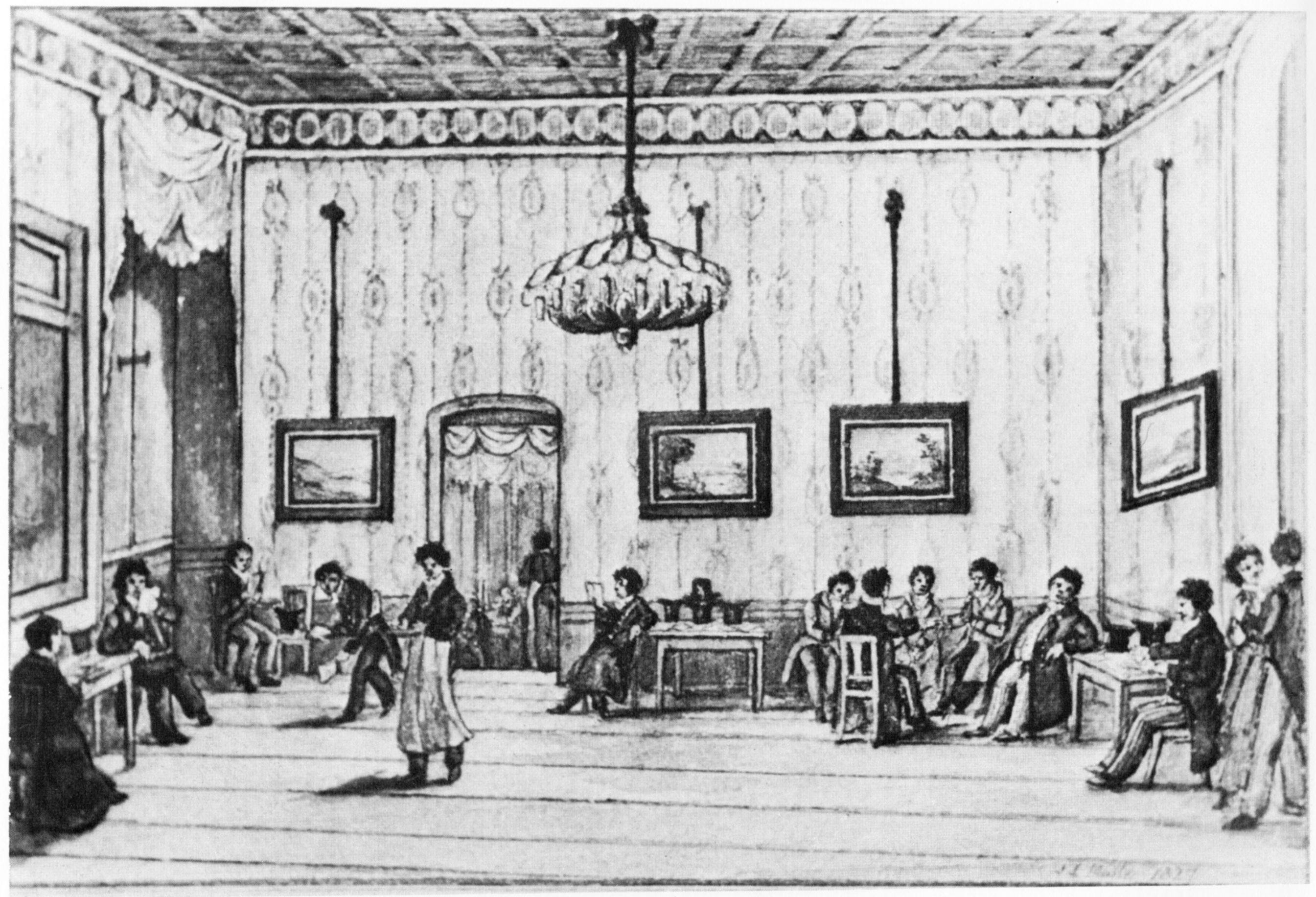
Much more is known about Stehely’s than Hippel’s. A helpful article simply titled Stehely contains some information about this “pastry shop and reading cabinet, the best-known meeting place for intellectuals, writers and journalists in Berlin during the Vormarz”. The shop was located at Charlottenstraße 36 on the border of the Gendarmenmarkt. Baked goods, ice cream, coffee, and liqueur including madeira was served. It had dark back room known as the “red room” a few steps higher than the main room which “was taken possession of by the politicians.” The cafe had a reading-cabinet with hundreds of local and national newspapers for guests to read. The cafe was owned by Johann Stehely, a Swiss pastry chef, who founded the shop in 1820. It was managed by two individuals named Frizzoni and Stoppani who both occur in the Wohnungsanzeiger listings for the location. Stoppani was apparently known for changing his political opinions throughout the day to suit his guests.
At midday the Prussian guard frequented Stehely’s and by the afternoon appeared professors, doctors, artists, and teachers. Friedrich Sass, who also appeared at the discussions at Hippel’s, said of Stehely’s that “to write the history of Stehely’s confectionery would mean nothing less than writing the literary history of Berlin” and that “it was here that the July Revolution and Hegel’s philosophy were delivered into the world by Young Germany, and where the whole business of those literary cliques found its centre. It was from here that one faction within Young Germany sought to combat the other; from here that the standpoint of Young Germany was first overcome, and from here that the Hallische Jahrbücher and the Rheinische Zeitung drew their artillery. One may say it without presumption: the young people, the new age, won its victory at Stehely’s.” Further, it was in the red room that the radical doctor’s club met, to which Max Stirner, Karl Marx, and Friedrich Engels belonged.
While never directly mentioning Hippel’s, both Marx and Engels mention Stehely’s. Engels when asked by Max Hildebrand about his relationship with Max Stirner and of the Free, said “We would meet at Stehely’s and, in the evenings, at this or that Bavarian ale-house in Friedrichsstadt or, if we were in funds, at a wineshop in the Poststraße, which was Köppen’s favourite haunt.” Marx mentions Stehely’s in the German Ideology, saying “This criticism of right is embellished with a host of episodes — all sorts of things which people are “in the habit” of discussing at Stehely’s between two and four in the afternoon.”
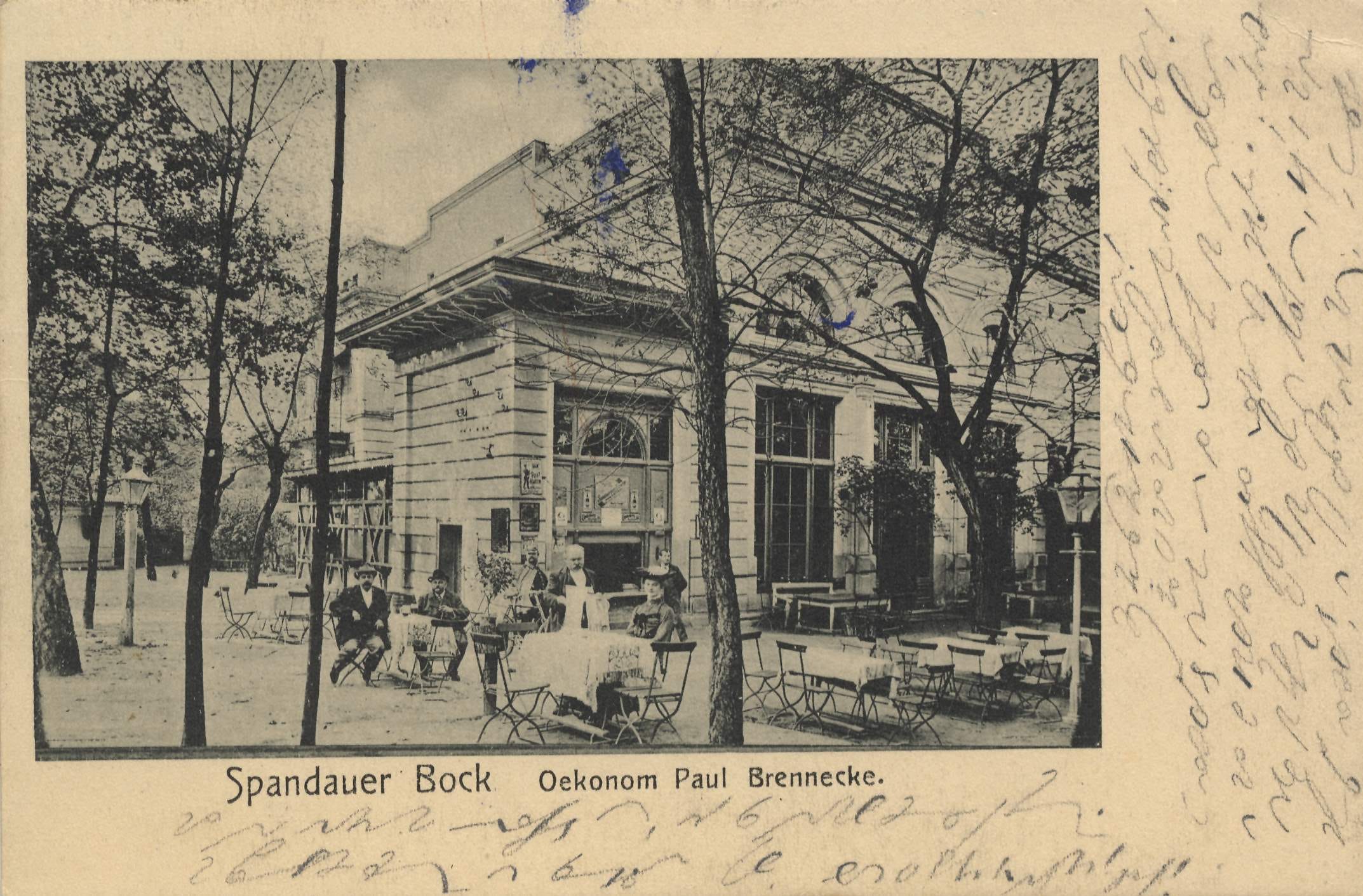
As for other locations, in summer joint excursions were made to the Spandauer Bock restaurant, as well as to Treptow and Kothen.
Finding an image of the bar
The Digitale Landesbibliothek Berlin has helpfully provided fully searchable address directories from about 1819 to 1970 online at https://digital.zlb.de/viewer/berliner-adressbuecher/. J. W. Boike’s allgemeiner Wohnungsanzeiger (general address directory) corroborates Mackay’s account of the bar existing at Friedrichstraße 94 in 1838 and 1842. The 1848 and 1849 editions, however, do not list any bar at Dorotheenstraße 8 but rather a bar run by Jakob Hippel at Dorotheenstraße 91. The move to Rosenstraße 3 is corroborated in the 1854 edition.
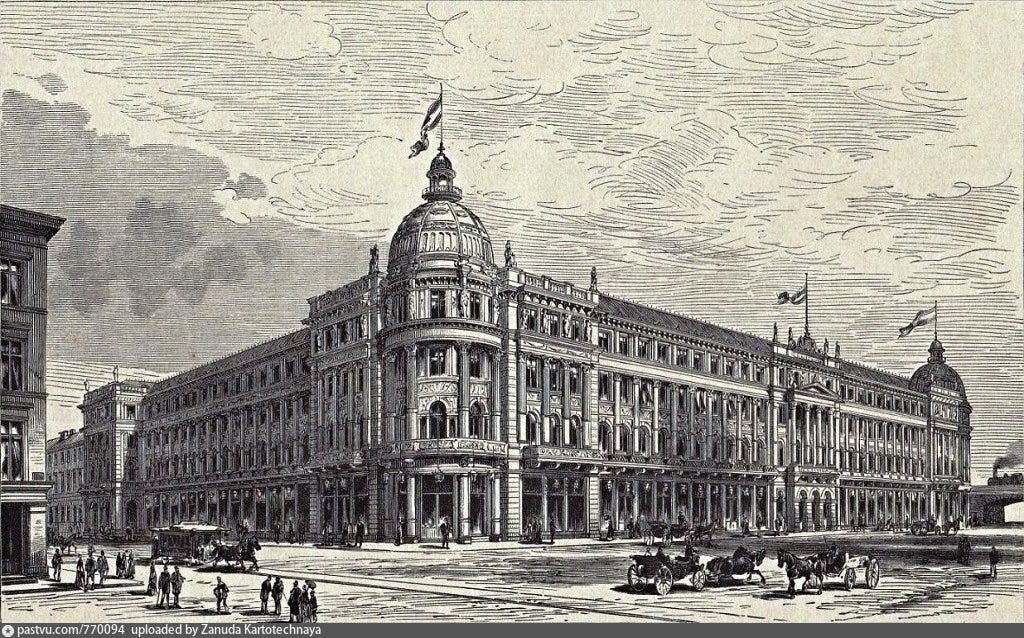
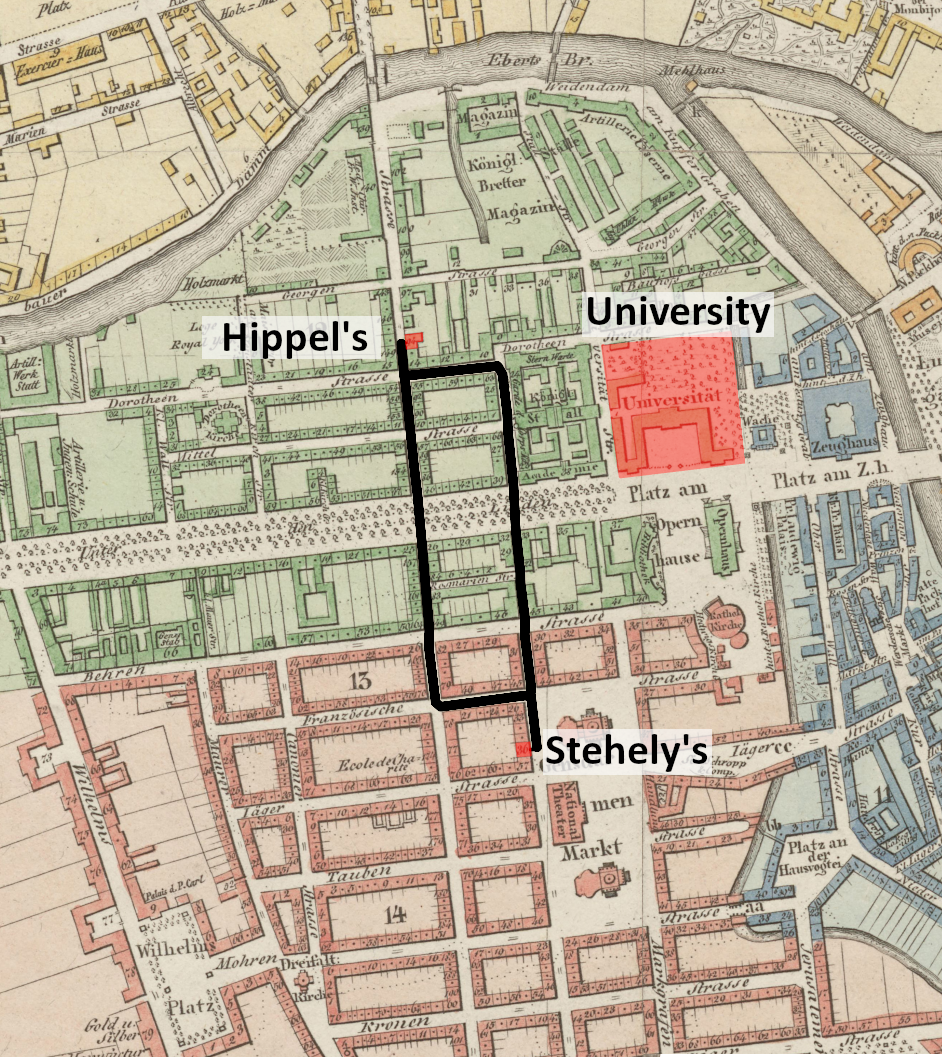
Looking at various old maps, including the 1832 “Neuester Grundriss von Berlin”, Friedrichstraße 94 remains in the same location today as it has since the 1830s (unlike some of the other locations mentioned). It lies on the eastern side between of the Friedrichstraße between Georgenstraße to the north and Dorotheenstraße to the south. The Central-Hotel mentioned by Mackay makes up the entirety of the block of buildings on the western side of Friedrichstraße between Georgenstraße and Dorotheenstraße.
As for the fate of the original premises, the Hippels continued to own it until 1866 with the 1850 edition listing Hippel’s widow as the owner. The 1860 edition lists Hippel’s widow still owning the location and J. C. R. Hippel operating a wine bar from the location, as well as a Ms. M. L. B. Hippel as a teacher. The 1865 edition lists J. C. R. Hippel operating as a trader, while the editions from 1866 onwards have no Hippels listed anywhere. Interestingly, the 1870 edition shows a chocolate and confectionary business owned by a J. Müller operating from Friedrichstraße 94. The 1903 edition of “Berlin and its Environs” also lists Müller as a confectioner operating from Friedrichstraße 94 “opposite the Central-Hotel” on page 12.
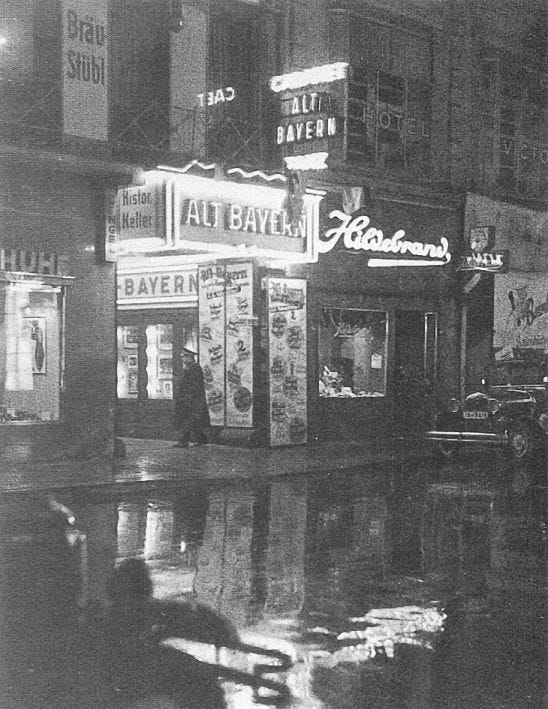
On the north corner of the eastern block was Aschinger’s Bierquellen / Aschinger-Haus on Friedrichstraße 97. To south of this lies the Hotel Silesia at 96. To the south is the location in question. Later operating on the same site as Hippel’s bar are the Kaffe-Restaurant und Konzerthaus Skandinavia on Friedrichstraße 94a-95, and the Alt-Bayern on Friedrichstraße 94/94a. Further south is the corner of Friedrichstraße 93 / Dorotheenstraße 22, which contains Hotel Friedrichshof. Opposite all of these is the Central-Hotel on Friedrichstraße 143–149 built in 1881. There are three key images to look at.
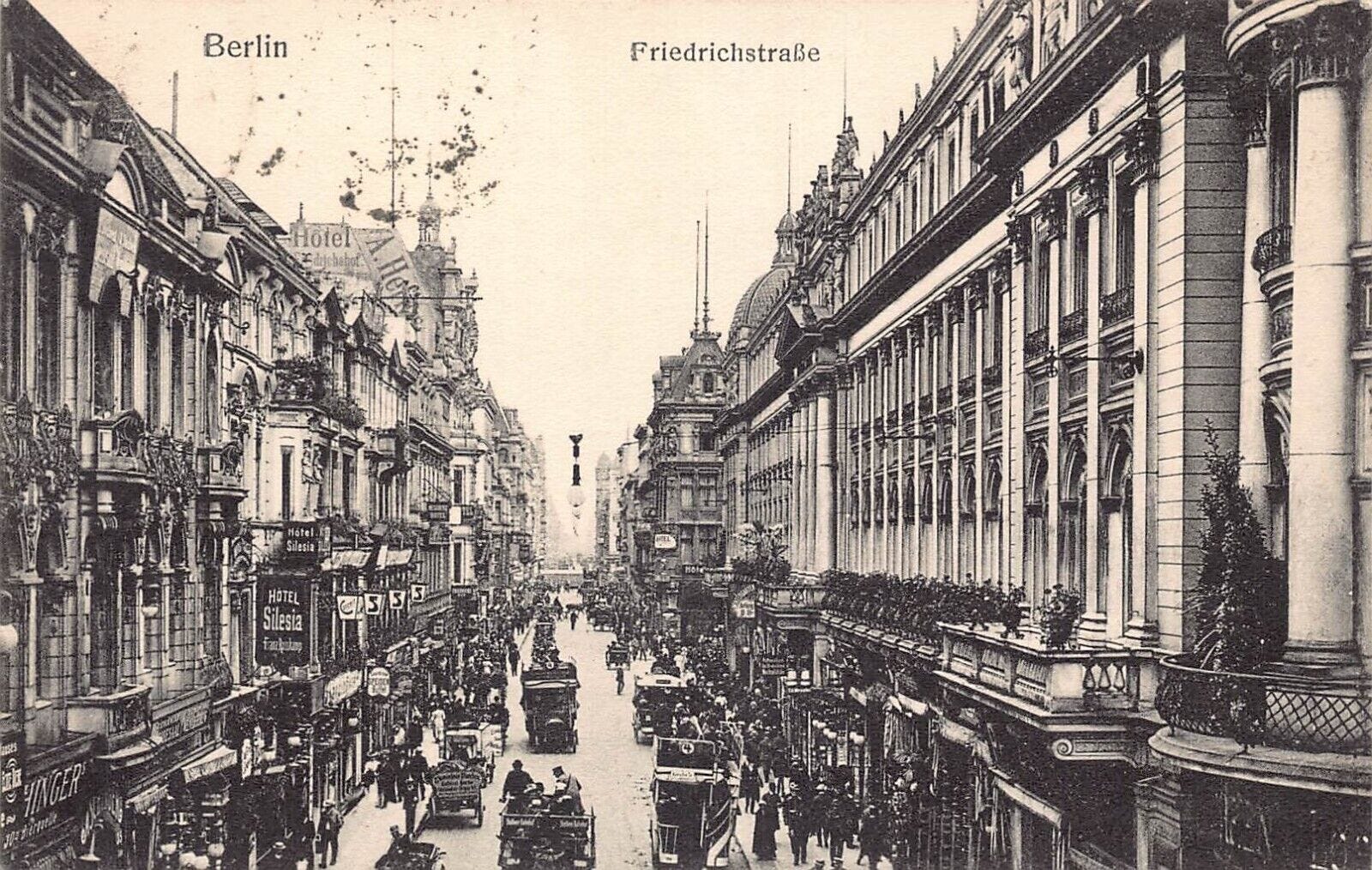
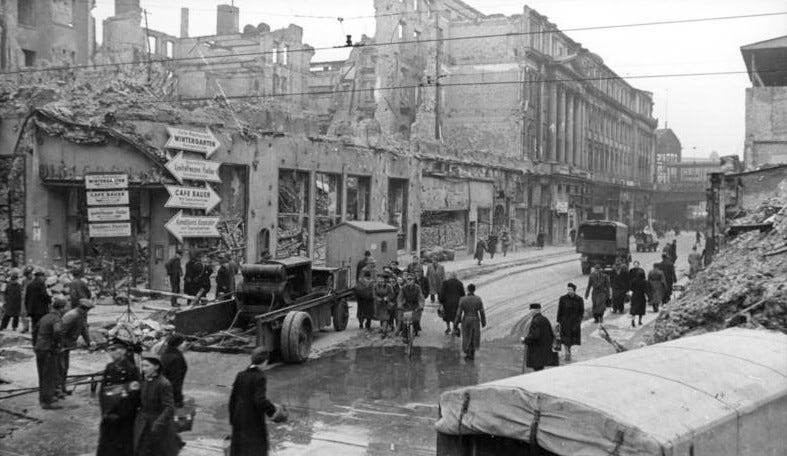
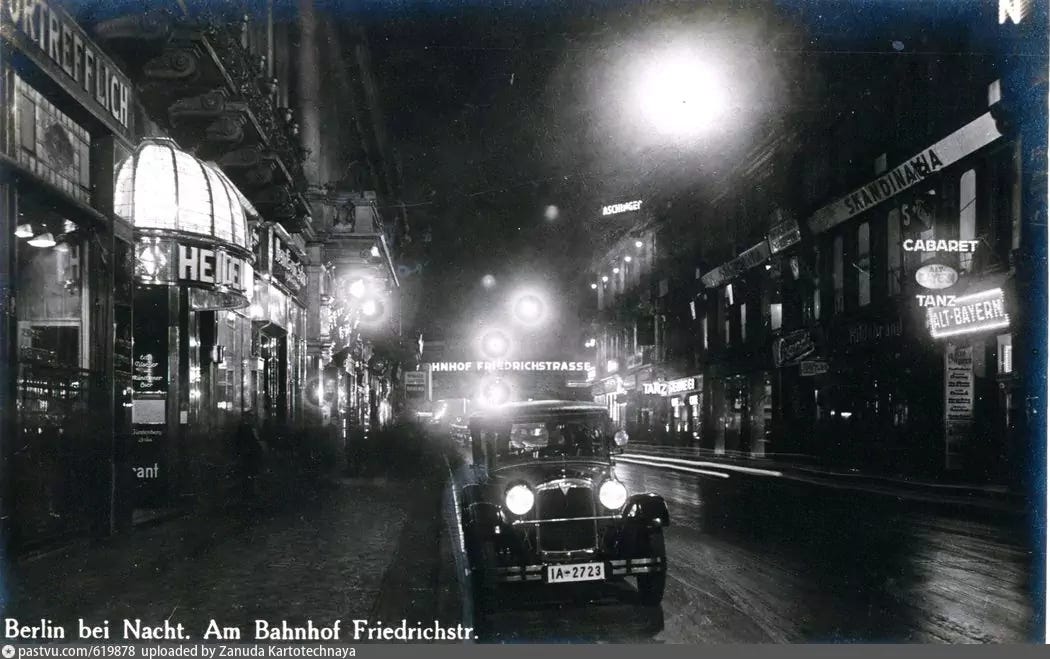
The first is this image from 1924 with a great view of the street and atmosphere but very limited view of the bar’s building itself. Visible in this image is, barely, the Aschinger in the very bottom left. On the building to the right, more visibly, is the Hotel Silesia sign. The three “S” signs of Cafe Skandinavia can also be seen.
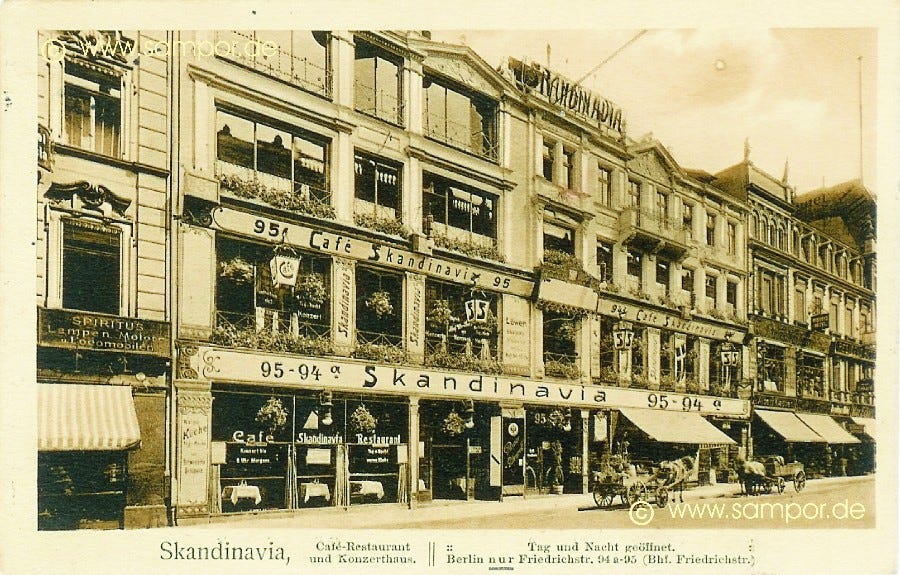
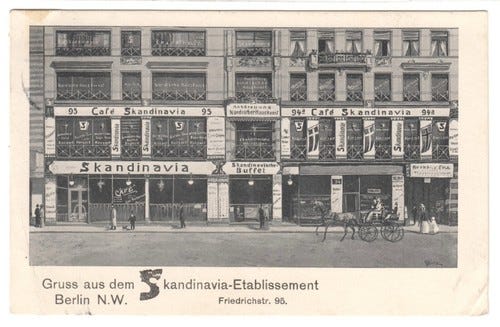
The next image is of Kaffe-Restaurant und Konzerthaus Skandinavia, taken in 1916. The building clearly displays that it exists on Friedrichstraße 94a-95 and is beside two buildings, one to the left and one to the right. We can know from our previous image that the left building is Hotel Silesia at 96, but this building to the right is not yet known. If it is the Hotel Friedrichshof at 93, then our Friedrichstraße 94 is in front of us as part of the Cafe Skandinavia. If, on the other hand, it is not the Hotel Friedrichshof, then this mystery building must be our Friedrichstraße 94.
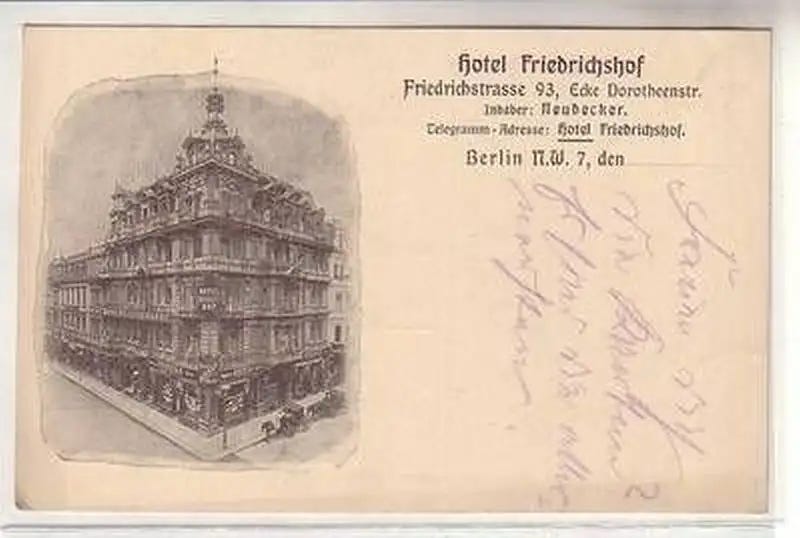
To the top right of this image, as well as in an equivalent spot in the top left of the first image, we can see above that there is some writing above this second building. It is from a third building looming overtop with some text on it. This text clearly reads “Hotel Friedrichshof”, suggesting that this mystery building is our former host of Hippel’s wine bar, and the looming building is the hotel on the corner. This brings us to our third image:
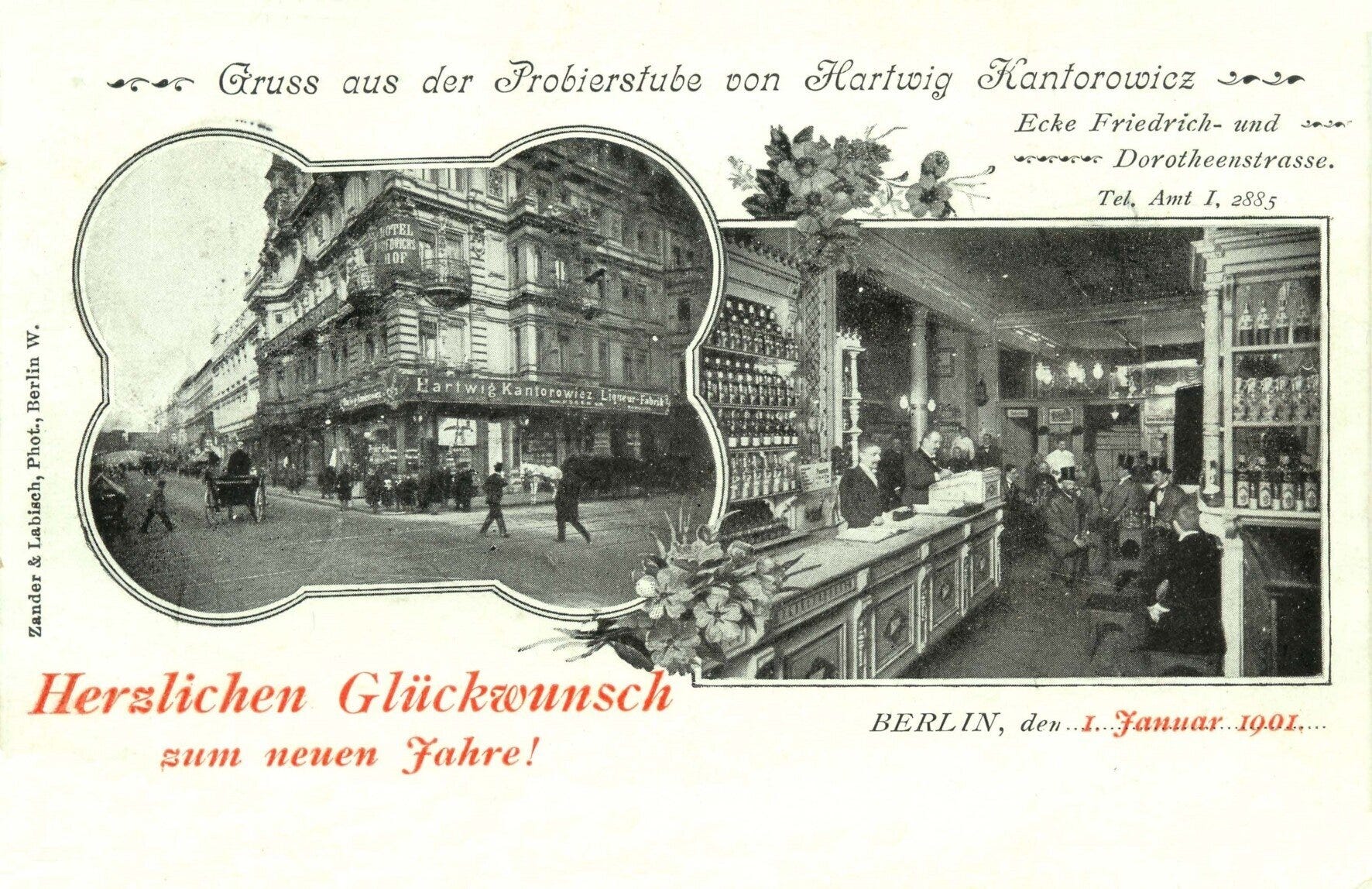
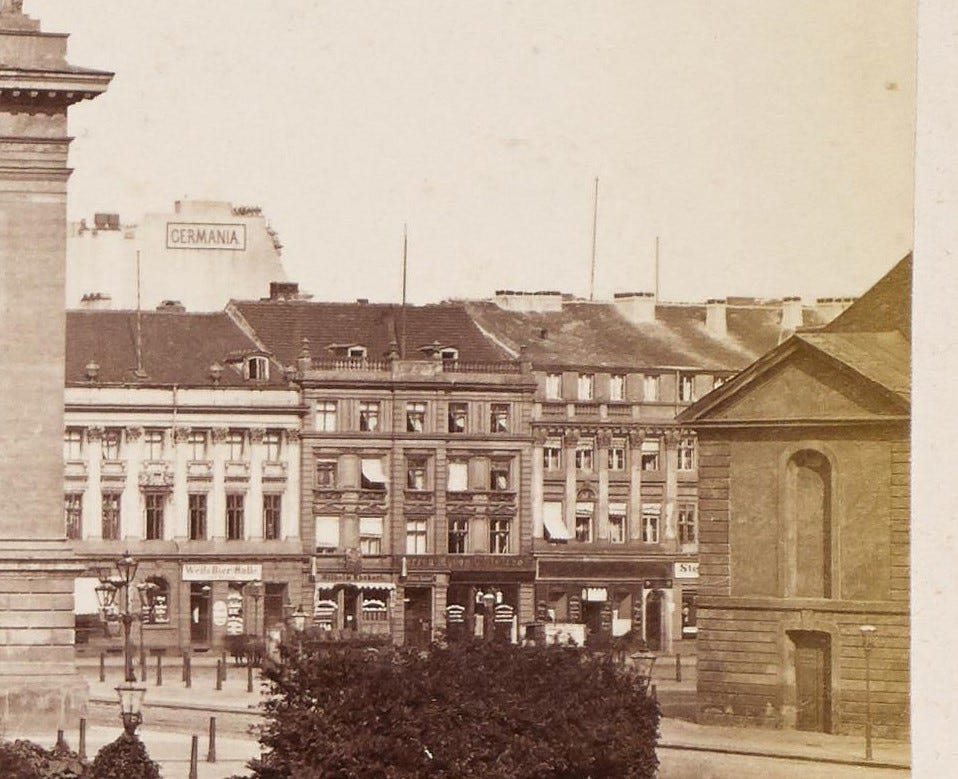
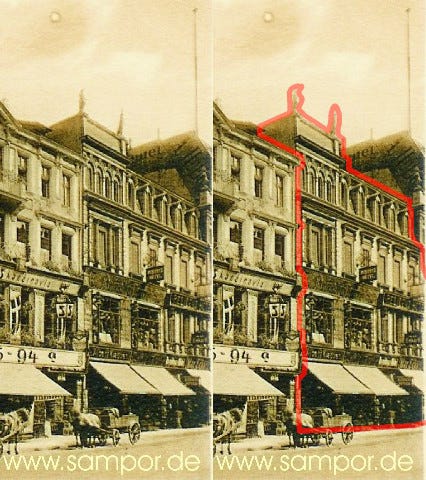
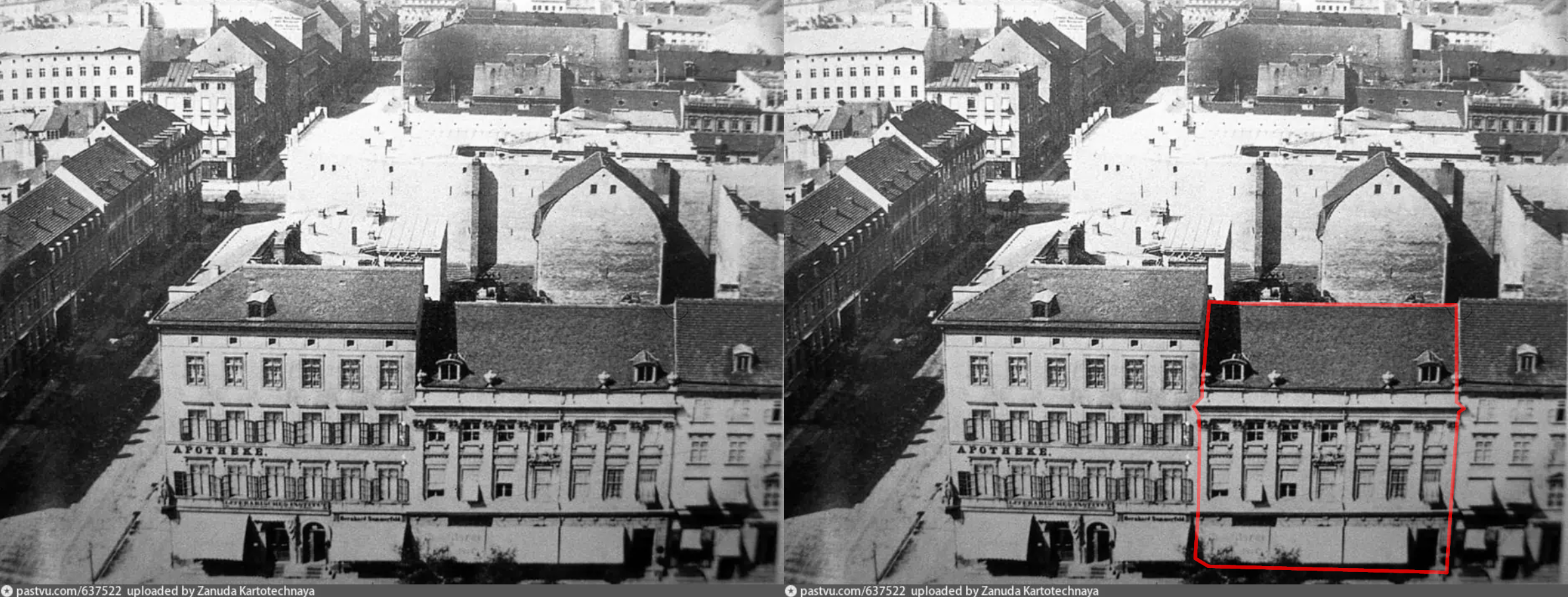
In this last image from 1901 we see the Hotel Friedrichshof, its name written on a sign on the corner angle of the building. When searching for this hotel there is another hotel with three spires that frequently appears. The three spired Hotel is actually from Friedrichstraße 41/42 and on the corner of Kochstraße. This image, however, shows the correct Hotel Friedrichshof on the corner of Friedrichstraße 93 / Dorotheenstraße 22. The important detail to notice is that the white building to the left touching this Hotel Friedrichshof is the same as the building to the right of the Kaffe Skandinavia in the second image. We can verify this as there is a raised part to the top left. We could also compare it to some hopelessly blurry images I’ll include later. Since this is Friedrichstraße 93 on the corner, and Kaffe Skandinavia is at Friedrichstraße 94a-95, that means our middle building must be Friedrichstraße 94. Based on Mackay’s descriptions, it is likely the same building as the one from the 1830s. Unfortunately this means our very best image that I have been able to find is this, with the building not even in focus:
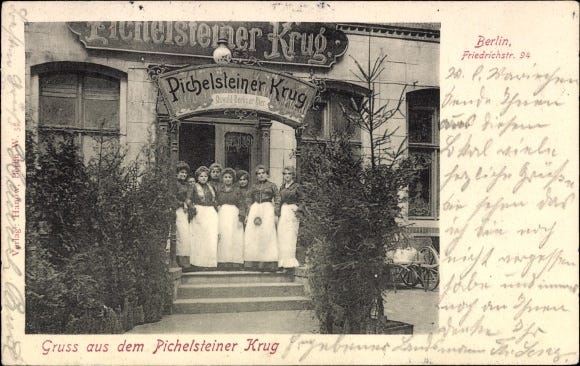
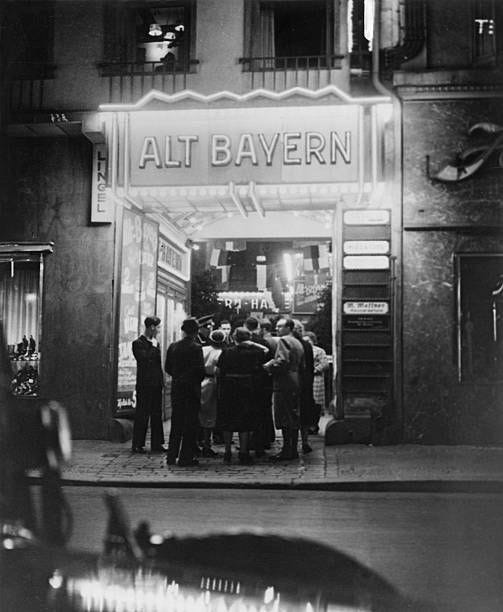
It is also possible to find images of two other enterprises that operated from the same site. Pichelsteiner Krug and the Alt Bayern Schenke / Old Bavaria Tavern both operated from Friedrichstraße 94. Interestingly, inside views of these are available, but it is hard to be sure that these are photos of the real building in question. The only images of the exterior of these buildings are rather unconvincing and in the case of Alt Bayern seem to have been in a new building. While the images of Pichelsteiner Krug may be of a courtyard behind the building, that I am pretty sure did exist, none of these images match with any surrounding buildings that I have been able to verify the age of. Certainly, the building was destroyed in World War II and today is occupied by the Berliner Volksbank across from Starbucks.
Finding an image of Stehely’s
I was also interested in locating Stehely’s cafe. If you consult the map from before again we can see some important details. Surrounding Stehely’s to the east is a large open area, which is the Gendarmenmarkt. It is just behind the northern most of those three large buildings in that open area, which is the Französischer Dom. This is a famous location with lots of historical depictions, although unfortunately Stehely’s is obscured in most of them.
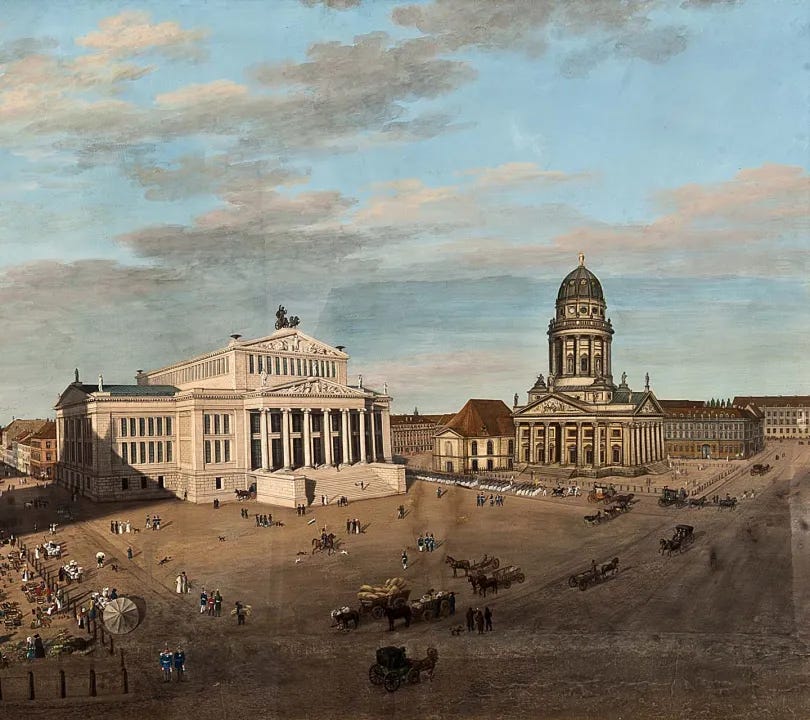
In this image the we see two large buildings: the Konzerthaus Berlin to the left, followed by the Französischer Dom to the right. Between the two, in the distance, is a view of the block of buildings which Stehely’s was in, except it probably cannot be seen here.
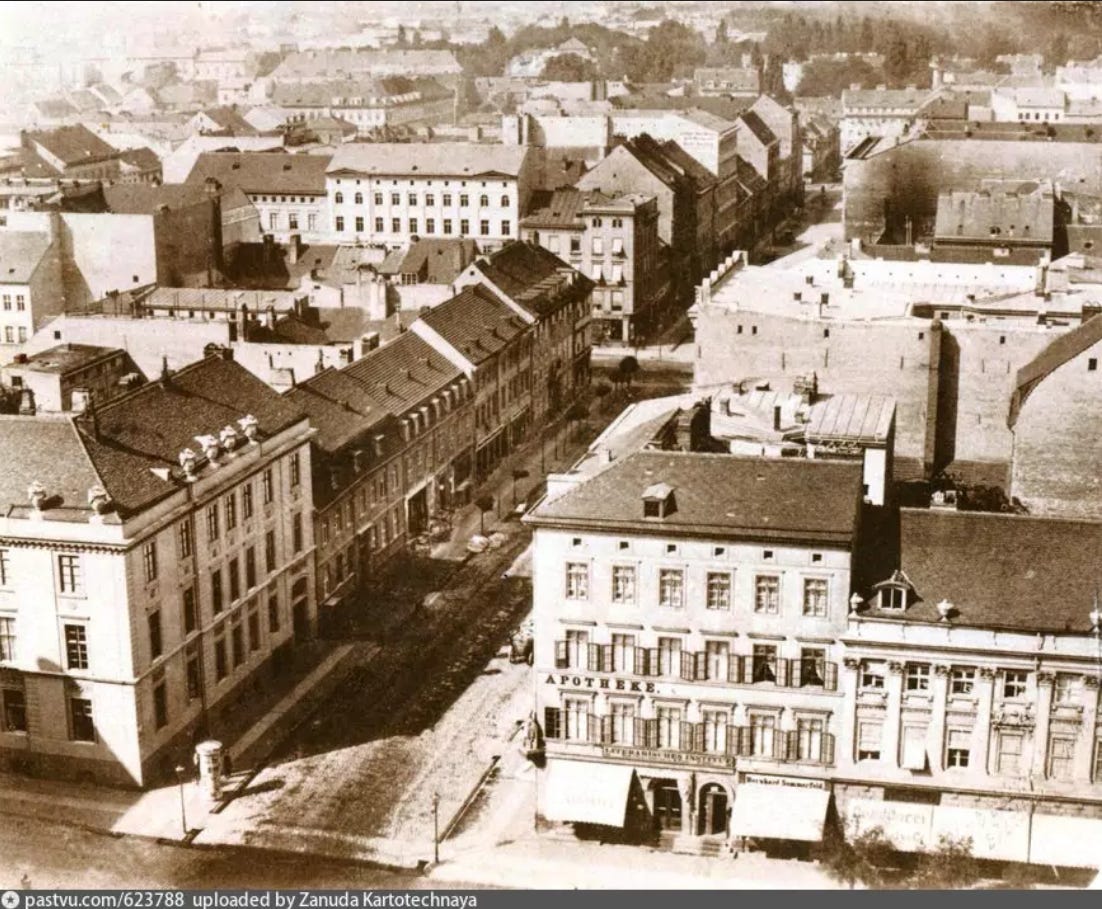
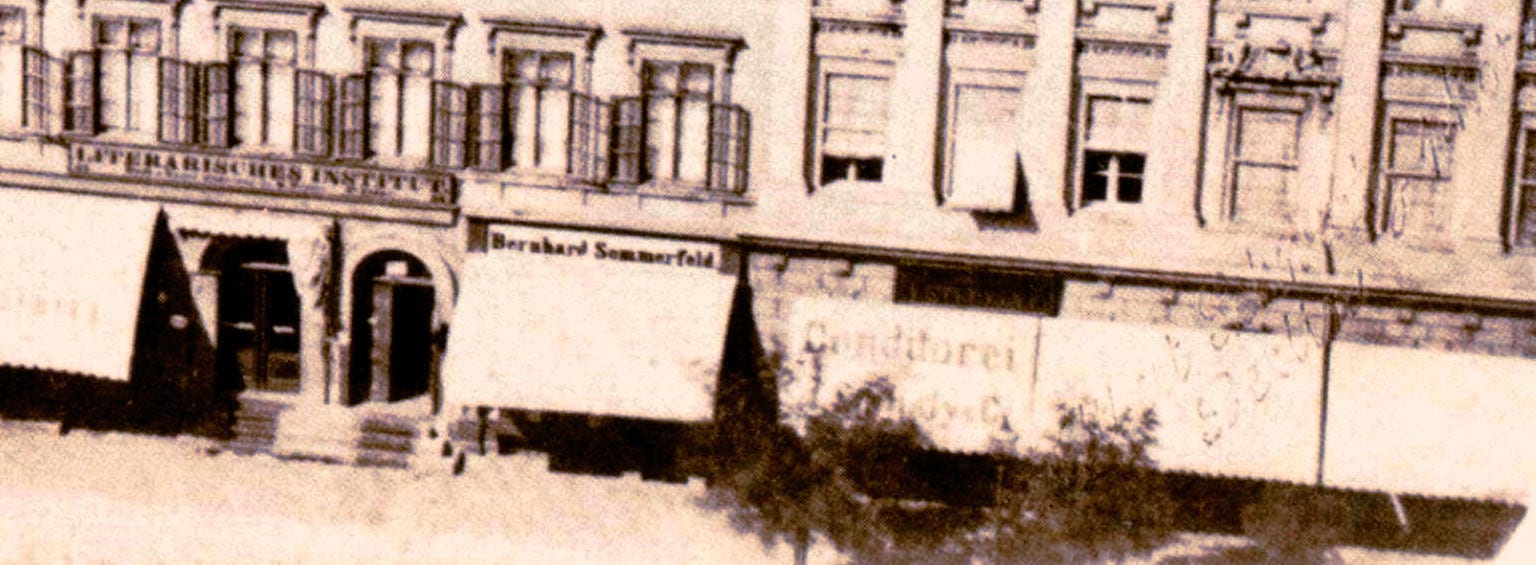
This image taken from the Französischer Dom, is of the corner of Jägerstraße and Charlottenstraße, A simple look at the map, as well as corroboration through some other images of the same corner, shows that the block of buildings on the right of the image contains our Stehely’s, and not only that but the confectionary is already in our sights. One lot to the north of the building on the corner lies Charlottenstraße 36. Further, the text “conditorei” (confectionary) followed by a word ending “-y & c” (quite possibly Stehely & Co.) are legible on the awning.
Attendees
Lastly I wanted to have a look at the attendees of these meetings of the Free at Stehely’s and Hippel’s. Mackay provides a very large list in his account:
Bruno Bauer
Edgar Bauer
Ludwig Buhl
Karl Köppen
Mussak, seminar teacher, colleague of Köppen
Eduard Meyen
Friedrich Sass, journalist
Hermann Maron, journalist
Adolf Rutenberg, brother-in-law of the Bauers
Arthur Müller (our later confectionary seller?)
Lieutenant Saint-Paul, officer assigned to observe the group
Ludwig Eichler
Zippel, philologist
Gustav Lipke, attorney
Gustav Julius, proprietor of a reading room
Karl Nauwerck, lecturer
Guido Weiss, journalist
Adolph Streckfuss
Feodor Wehl
Max Cohnheim, journalist
Albert Frankel
Adolph Wolff
Ludwig Koppe
Julius Lowenberg
G. Wachenhusen
Rudolph Gottschall, poet
Wilhelm Jordan, poet
Karl Beck, poet
Otto von Wenckstern, poet
Reinhold Solger, poet
J. L. Klein, dramatist
Albert Dulk, poet
Titus Ullrich, poet
Ernst Kossak, music critic and humorist
Heinrich UIke, painter
Wilhelm Caspary
David Kalisch
Rudolf Lowenstein
Ernst Dohm
Wilhelm Scholz
Julius Faucher
Friedrich Zabel, school teacher
Otto Michaelis, free trader
Otto Wolff
Theodor Mügge, novelist
Adolph Gumprecht, travel writer
Otto Gumprecht, music critic
Karl Marx
Friedrich Engels
Ernst Dronke
Hermann Raster
Alexander Kapp
Hieronymus Thrun, music teacher
Freiesleben, architect
Eduard Flottwell, civil service trainee, photographer
Enno Sander
W. von Neumann
Max Schasler, esthete
Twietmeyer Cornelius, book dealer
Wilhelm Cornelius, book dealer
von Forster, a witty cynic
Zehrmann, Mayor
Max Schmidt, painter
Freiherr von Gaudy
Alcibiades Faucher, brother of Jules
von Leitner
Nernst, jurist
Carl Noback
Julius Waldeck, doctor
The wife of Dr. Wiss
A married actress with a good reputation, whose name could not be found
Karoline Sommerbrodt, the wife of Faucher
“Mirabeau”, Buhl’s sweetheart
Louise Aston
Arnold Ruge, who attended only one gathering
Ludwig Ruge, who attended only one gathering
Otto Wigand, who attended only one gathering
Georg Herwegh, poet, who attended only one gathering
Hoffmann von Fallersleben, poet, who attended only one gathering, and before it was held in Hippel’s
Max Stirner
Marie Dahnhardt
Engels also provides some information about the gatherings of the Free. He famously drew a caricature in November 1842 which was found among his manuscript materials not attached to any letter or work. It depicts the long table of Hippel’s tavern as well as Ludwig Buhl, Karl Nauwerck, Bruno and Edgar Bauer, Max Stirner, Eduard Meyen, and Karl Köppen. Interestingly it also includes Otto Wigand and Arnold Ruge, who Mackay insisted only ever attended one session before Ruge became upset and stormed out.
In his letter to Max Hildebrand mentioned earlier he lists a few more including:
von Leitner
Mussak
Cornelius, the bookseller
Theodor Mügge
Dr J. Klein, the dramatist
G. Wachenhusen
Friedrich Zabel
Adolf Rutenberg
Julius Waldeck
He also mentions Jungnitz, Szeliga and Faucher who he says did not arrive until after he completed his year of military service and left Berlin, as well as specifying that Bruno Bauer only attended after and as a result of Edgar’s attendance.
The very last detail I will include is a poem Engels wrote in 1842, about Bruno Bauer titled “The insolently threatened yet miraculously rescued bible, or: the triumph of faith”. It portrays Bruno Bauer like Faust, selected by God to test the power of the Devil but contains some good descriptions of the Free. It comes in four “cantos” with the third probably being about Hippel’s wine bar and certainly about its frequent attendees. The third canto begins with a host (Hippel?) and a group of people coming from all parts of Germany to engage in conversation. Arnold Ruge tries to summon them to Bockenheim but they end up in Berlin.
What do I see? A frenzied host so glittering bright
With Blasphemy, the very sun has lost its light?
Who are they? See them, how they all come surging forth,
Foregathering from East, and South, and West, and North.
The scum of Germany, they meet in convocation
To whip their spirits up for still more evil action.
Arnold summons the Free to meet at Bockenheim.
Berlin it is that sends the most devoid of shame.
Broad Arnold heads them as they brashly march along;
Behind him mills a lunatic and loathsome throng.
And all that yelling gang, that Atheistic mob,
Is much more wild than ever was the Jacobin Club.
He then describes some of the regulars at the gatherings, starting with Karl Köppen:
That’s Köppen you can see there with his glasses on.
If Ruge but allowed, he’d be a virtuous man.
But Arnold’s raving fury has him so impressed:
He has a sword and wears it dangling from his waist;
It’s like a demon’s tail, a long and rusty thing,
And when he dances, see how bravely it can swing.
He’s wearing epaulettes and brandishing about
A stick with which to beat the thirst for knowledge out
Of flaming youth.
Eduard Meyen:
Next, Maien comes along, the Free;
Familiar everywhere to everyone is he:
An Atheist born, the vilest love him well: Voltaire
Ever since birth has been his daily reading fare.
So nice, so soft, so small—Maien, you devil, you!
Those ruffians with you making all that hullabaloo,
They’re not your nephews? Have you lured them in as well?
You’d take your family with you on your trip to Hell?
Friedrich Engels himself (”Oswald”):
Right on the very left, that tall and long-legged stepper
Is Oswald coat of grey and trousers shade of pepper;
Pepper inside as well, Oswald the Montagnard;
A radical is he, dyed in the wool, and hard.
Day in, day out, he plays upon the guillotine a
Single solitary tune and that’s a cavatina,
The same old devil-song; he bellows the refrain:
Formez vos bataillons! Aux armes, citoyens!
Edgar Bauer (”Radge”):
Who raves beside him, with the muscles of a brewer?
It’s old Bloodlust himself in person, Edgar Bauer.
His brown-complexioned face through bushy whiskers peers;
And he’s as old in cunning as he’s young in years.
Outside, a smart blue coat; inside he’s black, lacks polish;
Outside he’s dandified; inside he’s sansculottish.
His shadow’s with him, it’s a wonder to behold it;
His evil shadow’s there, and Radge he has called it.
Max Stirner:
See Stirner too, the thoughtful moderation-hater;
Though still on beer, he’ll soon be drinking blood like water.
And if the others shout a wild: à bas les rois! (Down with the kings!)
Stirner is sure to add: à bas aussi les lois! (Down with the laws as well!)
Ludwig Buhl:
Next, baring greenish teeth, comes tripping on his way,
His hair unkempt and tousled, prematurely grey,
A soap-and-water-shy and blood-shy Patriot,
So smooth and soft inside; outside a sansculotte.
Wild Arnold heads them, Czar of All the Atheists,
And high upon his baton’s end he twirls and twists
Copies of Halle Annals.
Bruno Bauer:
Next, there follow on
The crew that Satan’s picked to gorge himself upon.
As soon as they arrive, in bursts the frantic Bauer,
Engulfed in smoke and steam and Hell-rain’s deadly shower.
He raves, a lanky villain in a coat of green;
Behind the leering face Hell’s offspring can be seen.
He hoists his flag aloft, and in an arc up high
The sparks of his rude Bible criticisms fly.
Karl Marx:
Who runs up next with wild impetuosity?
A swarthy chap of Trier, a marked monstrosity.
He neither hops nor skips, but moves in leaps and bounds,
Raving aloud. As if to seize and then pull down
To Earth the spacious tent of Heaven up on high,
He opens wide his arms and reaches for the sky.
He shakes his wicked fist, raves with a frantic air,
As if ten thousand devils had him by the hair.
Georg Jung is not mentioned by Mackay, but probably appeared at the gatherings at least once:
Next, from Cologne, a Youngster, something of a swell,
Too bad for Heaven, too good to pass the gates of Hell.
He’s half a sansculotte, and half an aristo,
A suave rich gentleman with pleats in his jabot.
The pleats inside his soul add up to even more.
His pocket lining’s filled with demons by the score
With golden faces.
Adolf Rutenberg (“Rtg”):
Next, one who indeed disgusts,
The dawdling Rtg quite handy with his fists.
He has an evil habit: constantly he smokes
Hellish tobacco in an ell-long pipe which pokes
Out of his mouth, and which he never once removes
Except to give his utterance point when he reproves.
Finally he describes a scene in a bar:
And then he must be taken to a public bar.
At once, all hell breaks loose; the uproar is so loud
That nobody can gain the attention of the crowd.
They won’t sit still; they heave, and push, and shove around;
The Evil Spirit keeps them whirling round and round.
Their loathing of inaction gives them all no peace;
And futile calls for quiet continue without cease.
Then Köppen, that most virtuous, order-loving chap,
Flies off into a rage. “Is this the savage steppe?
Have you forgotten in this wild barbaric throng
What was the purpose of our journey all along?
O Arnold, trusty bastion, speak, start the discussion.
Will you not show us how to find the best solution?”
Oswald and Edgar shout in roaring unison:
“Now that’s enough of these disgraceful goings-on!”
Then silence fell. And Arnold, who, quite guiltlessly,
Had in the meantime been consuming beefsteaks three,
On the last mouthful seemed as if about to choke,
But managed in the end to get it down, and spoke:
“Oh, what a lovely vision’s there in Unity: Free brethren, ever
Ready for battle and for death, obedient should the Idea command.
Reaction holds us by the hair, it lifts the stick with threatening hand,
But it can never tame us, Friends, if we stand firm as
Oswald and Edgar cannot wait until he’s done. one together.”
They both jump on the table, then they shriek as one:
“Ruge, we’ve had enough of all this talk from youl
What we want now is deeds, not words. We want some action!”
A frenzied bravo! is the ill-advised reaction;
Everyone keeps demanding: “Action, action, action!”
Then with a mocking laugh shouts Arnold in reply:
“Our actions are just words, and long they so shall be.
After Abstraction, Practice follows of itself.”
Meanwhile, athirst for deeds, the wildly screaming pair
Have lifted crazy Bruno high on to a chair.
A crowd swarms round him and he’s hoisted really high.
Aloft, he hovers like an eagle in the sky.
With frenzied burning passion are his eyes aglow,
And lowering black with fury is his furrowed brow.
Today nothing remains of the original buildings, and even the best images I could find are half obscured. These places weren’t well known even in their time. Hippel’s was a noisy wine bar filled with smoke, arguments, bad jokes, and especially young writers half-serious even in their most serious convictions. From these places, however, emerged ideas that would travel far beyond Berlin. I’ll leave you with the images of the two locations discussed:


Here are some other related images I found interesting: